
Medicare HH (PDGM)
The full PDGM pipeline. Built in. Not a "module."
Most platforms charge extra for a "PDGM module" or push you to a third-party Grouper. Carelytics ships the entire pipeline as part of the platform — what-if classifier, LUPA Risk Dashboard, NOA Tracker with one-click clearinghouse submission, and HIPPS-injected episode claims.
432 HHRGs
~75K ICD-10 crosswalk codes
504 CBSA wage indices
117 comorbidity subgroups
app.carelytic.ai/billing/pdgm/grouper-preview
CY2026 PDGM data, bundled
Specifics, not adjectives.
Extracted from CMS HH Grouper Software v07.0.26 and shipped with the platform. No external Grouper service. No "we'll integrate with it next quarter."
Grouper Preview
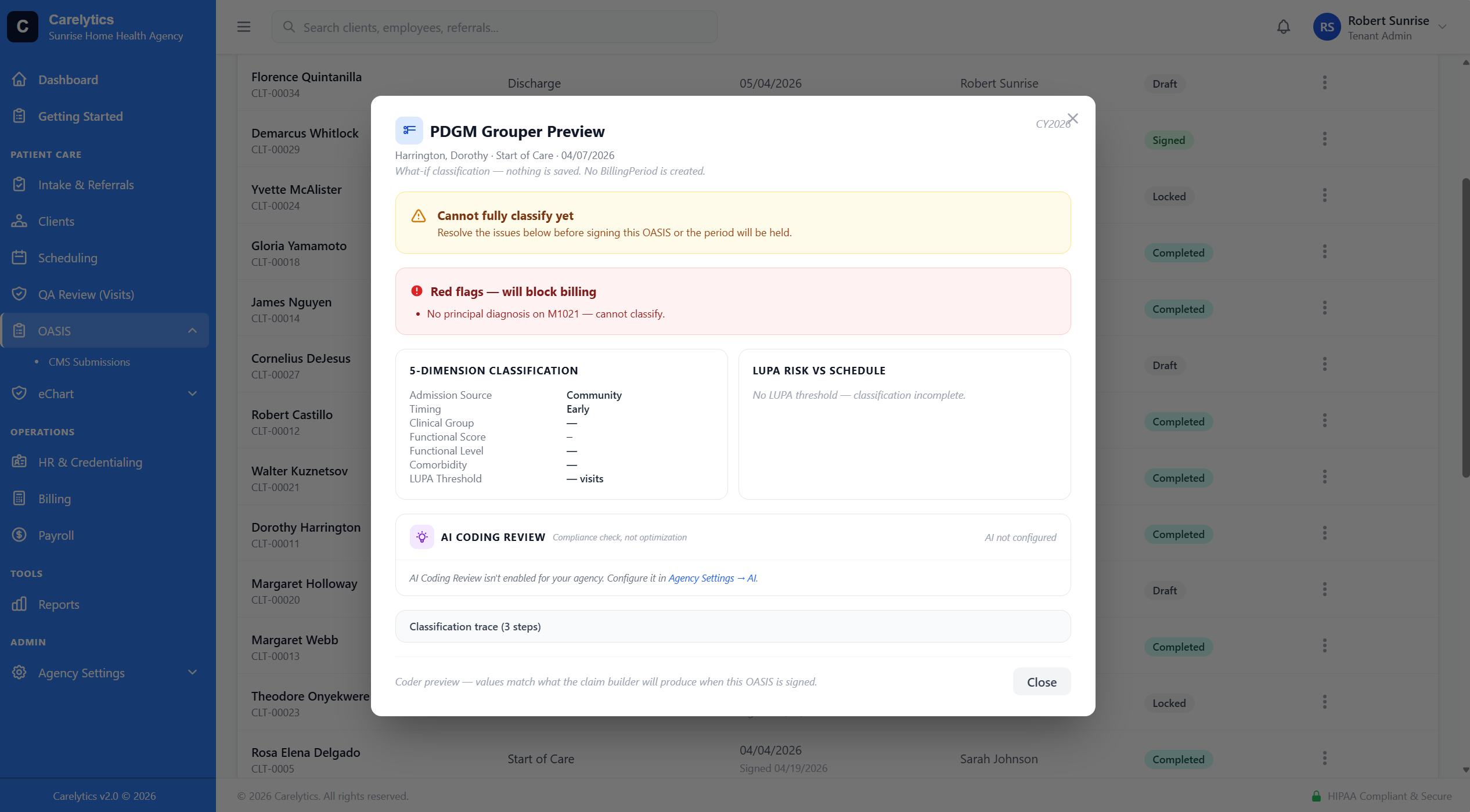
Catch coding errors before signing the OASIS.
Open any OASIS draft, click Grouper Preview, see the 5-dimension classification resolve live. If the primary diagnosis or comorbidity groupings look wrong, fix them in the OASIS — not after the claim rejects.
- Admission Source — Community vs Institutional
- Timing — Early vs Late
- Clinical Group — 12 PDGM clinical groups
- Functional Level — Low / Medium / High from OASIS M-items
- Comorbidity — None / Low / High via interaction pairs
- Output — HHRG · CMW · 30-day payment estimate · LUPA threshold
app.carelytic.ai/billing/pdgm/grouper-preview
app.carelytic.ai/billing/pdgm/lupa-risk
LUPA Risk Dashboard
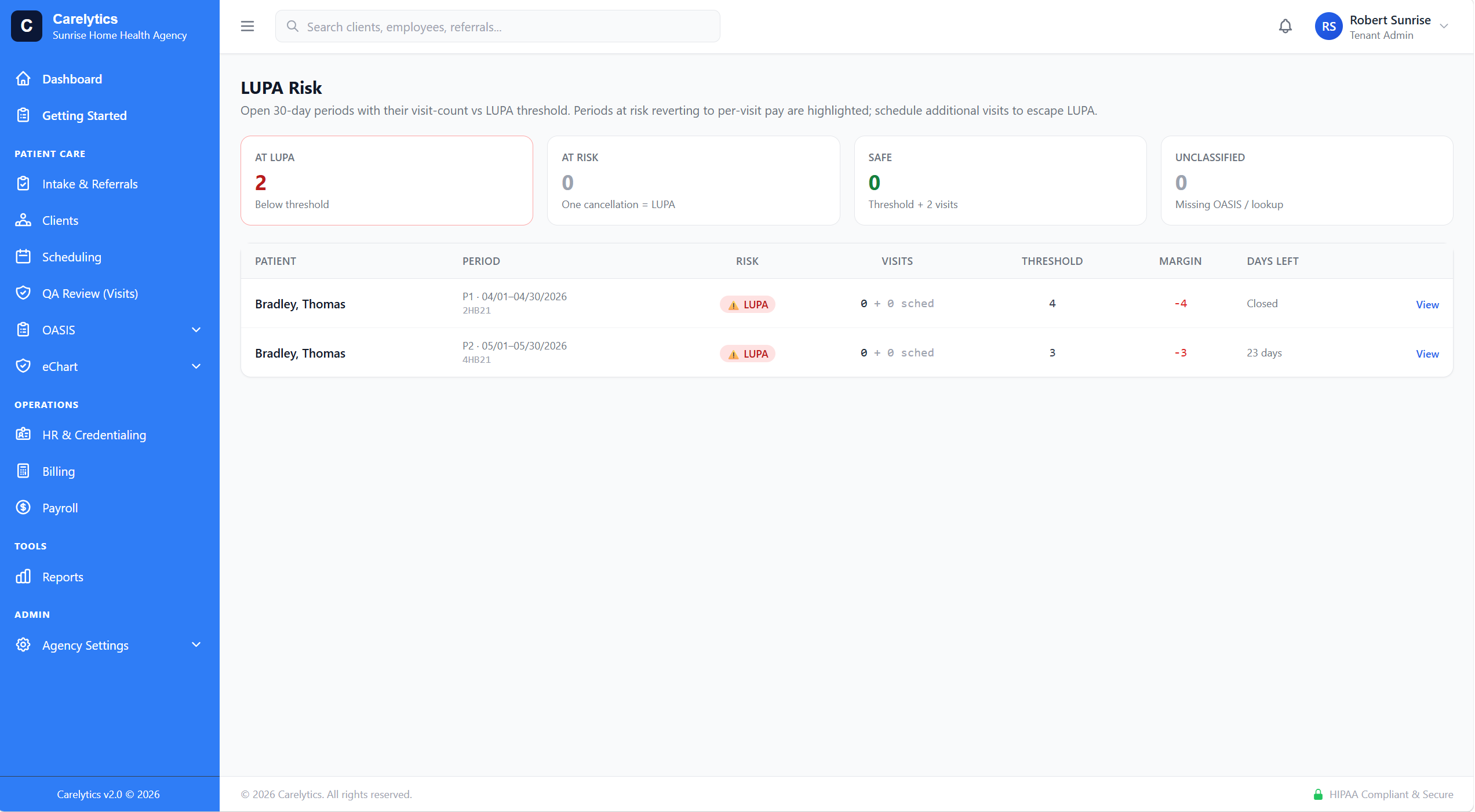
You'll see the LUPA before it happens.
For every open 30-day billing period, Carelytics computes the LUPA threshold (per HHRG) and compares it to scheduled + completed visits. At-risk periods are flagged in real time — not at end-of-period when it's too late to add a visit.
- Per-30-day-period LUPA threshold from the HHRG-specific PDGM table
- Visit count combines completed + scheduled within the period
- Color coding: Below · At risk · Clear
- Sorted with worst at the top — schedulers know what to fix
HETS eligibility
Original Medicare eligibility checks happen inside Carelytics.
Original Medicare (FFS) eligibility uses the CMS HETS endpoint — which requires every
agency to sign the HETS Trading Partner Agreement before sending a single 270.
Most platforms hand you a link to hets.cms.gov and tell you to come back
when you're attested. Carelytics keeps the entire flow in-platform.
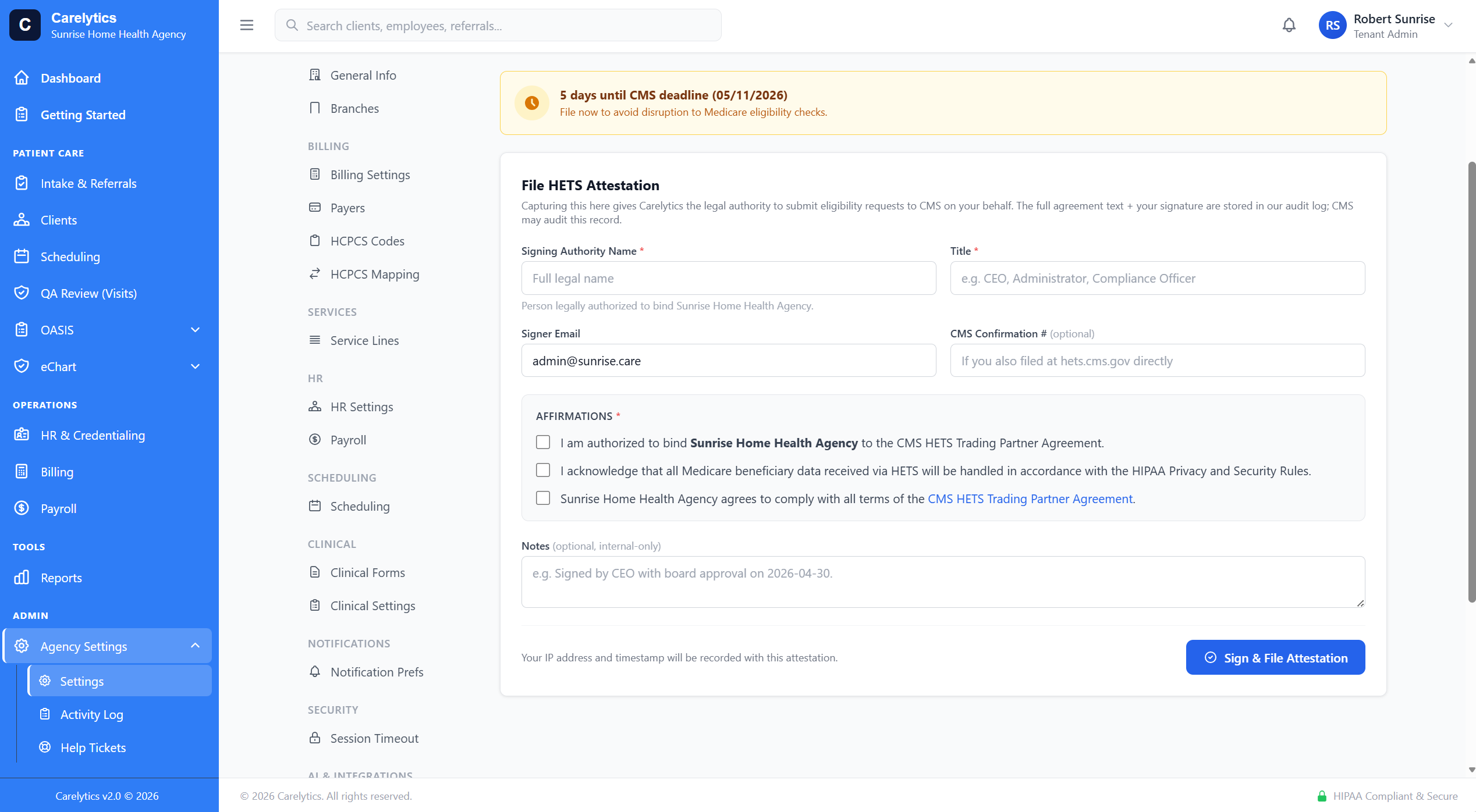
- In-app HETS attestation — Settings → Compliance → HETS Attestation
- Captures signer name, title, IP, timestamp, exact agreement text + version
- Immutable audit log — required by CMS for the trading partner relationship
- Required by the 2026-05-11 CMS deadline for Medicare FFS eligibility checks
- Once attested, "Verify eligibility" works for FFS patients on the patient detail page
app.carelytic.ai/settings/compliance/hets
Notice of Admission
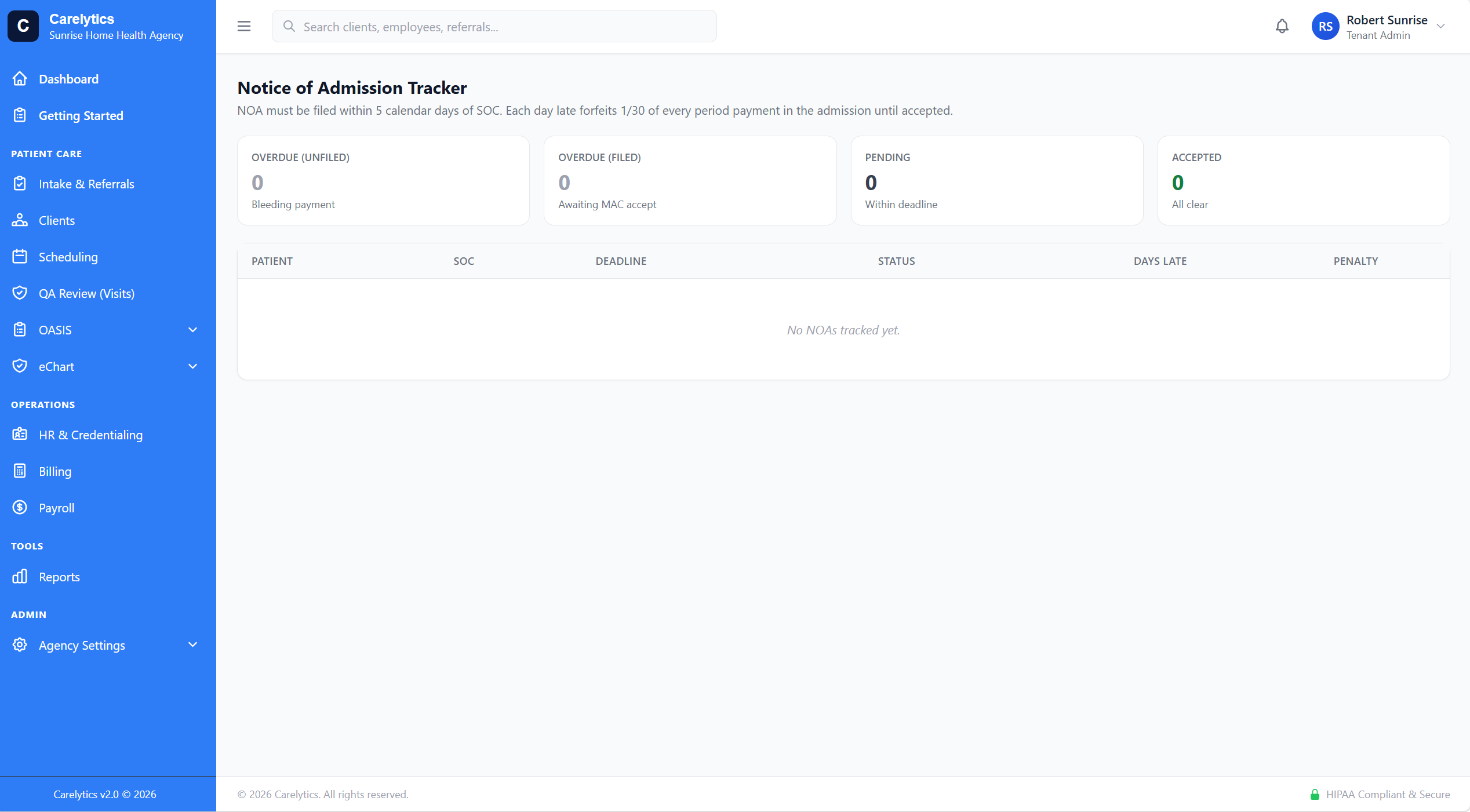
5-day countdown. Daily penalty math. One-click clearinghouse submit.
The CMS NOA window is 5 days from SOC. Miss it and you lose 1/30 of the episode payment per day. Carelytics shows the countdown and the penalty math next to every patient who needs an NOA — and submits via your clearinghouse when the clinical team is ready.
- 5-day deadline countdown from SOC date, per patient
- 1/30 daily penalty calculated and displayed (lost dollars)
- Status badges: Not submitted Submitted Accepted Rejected
- Clearinghouse submission as TOB 32A 837I
- Real-time status polling — accepted/rejected reflects in dashboard automatically
app.carelytic.ai/billing/pdgm/noa
Episode Claims
HIPPS injected. TOB-derived frequency. One claim per 30-day billing period.
HIPPS code on revenue 0023
The HIPPS code from the Grouper output is injected on revenue code 0023 with the HP procedure qualifier — exactly as CMS expects. No manual entry.
TOB-derived claim frequency
322 (continuing), 329 (final), 327 (replacement), 328 (void). Frequency code is derived from the BillingPeriod state — not picked from a dropdown.
One Claim per 30-day BillingPeriod
The episode is split into 30-day BillingPeriods at SOC. Each period produces one Claim. Adjustments and resubmissions stay tied to the same period.
Submitted as 837I
Same clearinghouse you use for 837P (non-HH) and 835 ERA. One enrollment, one credentials store, all transaction types.
Edge cases we've already solved
Per-state EVV midnight boundaries. Overnight shifts. State-specific exports.
NC midnight = 00:01:00
North Carolina's EVV aggregator splits at 00:01:00, not 00:00:00. Carelytics's per-tenant EVV settings handle that — your overnight visit reports the right minutes to the right side of the boundary without manual fixing.
One visit, two billing periods
An overnight visit that crosses a 30-day billing period boundary auto-splits at midnight when exporting to billing claims and EVV state aggregators. The clinician still clocks in once and clocks out once.
Configurable per tenant
Multi-state agencies set per-state EVV thresholds (late check-in, early check-out, location radius, minimum duration percentage) without code changes. Single source of EVV truth.